Backhouse's Pancake Functions: A Single-Knob Family of Strict-GPAC π
2026-04-26
The previous post recorded ζ(5) as the headline open holonomic constant — no exact-limit PIVP under the strict-GPAC bar. The opposite end of the difficulty axis is π itself: it now has not just one strict-GPAC construction, but a one-parameter family parameterized by an integer $k \ge 1$. Each $k$ gives a distinct PIVP whose continuous-time limit is exactly π, with all states bounded natively (no surrogate compilation needed) and all coefficients rational. The construction is the Backhouse 1995 pancake-function family combined with the Medina 1944 / Lucas 2009 closed-form residual decomposition. A short note on what the knob $k$ buys, and what it doesn’t, follows.
Setting
$$ J_n \;=\; \int_0^1 \frac{x^{4n}(1-x)^{4n}}{1+x^2}\,dx $$$$ J_n \;=\; A_n - \pi B_n, \qquad B_n = -\frac{(-4)^n}{4}, $$with $A_n$ a rational that satisfies a 2nd-order P-recurrence with polynomial coefficients of degree 7, all in $\mathbb{Z}[n]$.
The crucial structural fact is that $B_n$ is first-order constant-coefficient in $n$: it satisfies $B_{n+1} + 4 B_n = 0$, so its generating function is $G_B(z) = -1/[4(1+4z)]$, a rational function with a simple pole at $z = -1/4$. Only $A_n$ carries 2nd-order holonomic content. Since $B_n$ collapses to geometric, the residual $J_n / B_n \to 0$ implies $A_n / B_n \to \pi$ at rate $4^{-n}$ — about 2.4 decimal digits per term.
The Lehmer-Lucas-Medina construction compiles to a polynomial PIVP in state count 12 (continuous-time analogue of the recurrence), gives $\pi$ in the continuous-time limit, and was recorded in the previous post on the residual route.
This post extends the construction to a one-parameter family, due to Backhouse 1995, that turns the per-step rate into a tunable knob and delivers strict-GPAC π at arbitrary geometric rate.
The Backhouse pancake family
$$ P_{m,n}(x) \;=\; \frac{x^m (1-x)^n}{1 + x^2}, \qquad I_{m,n} \;=\; \int_0^1 P_{m,n}(x)\,dx. $$$$ x^m (1-x)^n \;=\; (1 + x^2)\, Q_{m,n}(x) \;+\; (A_{m,n} + x B_{m,n}), $$$$ i^m (1-i)^n \;=\; A_{m,n} + i\, B_{m,n}. $$So $A_{m,n}, B_{m,n}$ are read off the real and imaginary parts of $i^m (1-i)^n$ — concrete integers, easy to compute.
$$ I_{m,n} \;=\; R_{m,n} \;+\; A_{m,n}\,\frac{\pi}{4} \;+\; B_{m,n}\,\ln\sqrt 2, $$with $R_{m,n} \in \mathbb{Q}$ the rational integral of the polynomial quotient $Q_{m,n}(x)$.
For a clean π formula we want $B_{m,n} = 0$ — no $\ln\sqrt 2$ pollution. Working out when $B_{m,n} = 0$: this happens exactly when $2m - n \equiv 0 \pmod 4$.
The k-family
$$ I_{4kn,4kn} \;=\; R_n^{(k)} \;+\; A_n^{(k)}\,\frac{\pi}{4}. $$$$ i^{4kn} (1-i)^{4kn} \;=\; \bigl((1-i)^4\bigr)^{kn} \;=\; (-4)^{kn}. $$$$ \boxed{\;\pi \;=\; \frac{4 I_{4kn,4kn} - 4 R_n^{(k)}}{(-4)^{kn}}.\;} $$The error term is $4 |I_{4kn,4kn}| / 4^{kn}$. The integrand $(x(1-x))^{4kn}/(1+x^2)$ on $[0,1]$ is bounded by $(1/4)^{4kn}$ because $x(1-x) \le 1/4$ on $[0,1]$, so $|I_{4kn,4kn}| \le 1/4^{4kn} = 4^{-4kn} = 2^{-8kn}$. The total error is $\le 4 \cdot 2^{-10kn}$.
Per-step rate of the symbolic identity: $2^{-10k}$, equivalently $\log_{10}(2^{10k}) \approx 3.01\,k$ decimal digits per recurrence step.
| $k$ | Digits per recurrence step | Source |
|---|---|---|
| 1 | 3.01 | Lehmer-Lucas-Medina, the original |
| 2 | 6.02 | Verified in code/backhouse_k2.py |
| 5 | 15.05 | — |
| 10 | 30.10 | — |
A caveat to underline immediately, before the table is read as more than it is: this is the per-step rate of the underlying discrete recurrence, not the continuous-time rate of the PIVP one builds from it. The two live on different axes. We come back to this below in the section on what the knob $k$ actually buys.
The recurrence on $R_n^{(k)}$
$$ V_n^{(k)} \;:=\; R_{n+1}^{(k)} - (-4)^k R_n^{(k)} \;=\; \frac{(4kn)!^2}{(8kn + 8k - 1)!}\, Q_k(n), $$where $Q_k(n)$ is a polynomial in $n$ of degree $8k - 2$. (For $k = 1$, this matches Lucas’s $Q_1(n) = 16(820 n^3 + 1533 n^2 + 902 n + 165) \cdot (4n+1)(4n+2)(4n+3)$ — degree 6.)
$$ D_k(n)\, V_{n+1}^{(k)} \;=\; N_k(n)\, V_n^{(k)}, $$$$ D_k(n)\, R_{n+2}^{(k)} \;=\; \bigl((-4)^k\, D_k(n) + N_k(n)\bigr)\, R_{n+1}^{(k)} \;-\; (-4)^k\, N_k(n)\, R_n^{(k)}. $$The polynomial coefficients have degree $8k - 1$. Verified
symbolically in code/backhouse_k2_recurrence.py: for $k = 2$, the
coefficients are degree 15 polynomials, and $n = 0, \ldots, 12$ all
satisfy the recurrence.
The pattern of degrees:
| $k$ | $\deg Q_k$ | $\deg N_k = \deg D_k$ | recurrence-coef degree |
|---|---|---|---|
| 1 | 6 | 7 | 7 |
| 2 | 14 | 15 | 15 |
| $k$ | $8k - 2$ | $8k - 1$ | $8k - 1$ |
The complete PIVP for $k = 1$ (Lehmer-Lucas-Medina)
The construction is cleanest at $k = 1$, so we write the full system out explicitly and report the higher $k$ as the same shape with longer polynomial coefficients.
The discrete recurrence. Lucas (2009, eq. (11)) records the explicit 2nd-order recurrence on $A_n$ (the rational from $J_n = A_n - \pi B_n$), which after clearing denominators reads
$$ \begin{cases} D(n)\,A_{n+2} \;=\; N_1(n)\,A_{n+1} \;+\; N_0(n)\,A_n,\\[2pt] A_0 \;=\; 0, \qquad A_1 \;=\; 22/7. \end{cases} $$$$ \begin{cases} D(n) \;=\; 16\,P(n)\,(8n+9)(8n+11)(8n+13)(8n+15),\\[2pt] \rho(n) \;=\; P(n+1)\,(4n+1)(4n+2)(4n+3)(4n+4),\\[2pt] N_1(n) \;=\; \rho(n) - 4\,D(n), \qquad N_0(n) \;=\; 4\,\rho(n), \end{cases} $$
all in $\mathbb{Z}[n]$ of degree 7. Derivation in code/lehmer_OGF_ODE.py.
with $D(-1) = -40320$ and right-hand side $-126720\,z$. Expanded
into $L = \sum_{l=0}^{7} c_l(z)\,(d/dz)^l$ via $\theta^k = \sum_l
S(k,l)\,z^l (d/dz)^l$ (Stirling 2nd kind), the operator has order 7
in $z$ with polynomial coefficients $c_l(z)$ of degree $l + 2$
(explicit forms in code/lehmer_OGF_ODE.py). $G$ has a simple pole
at $z^* = -1/4$ from the $-\pi B_n$ piece and is analytic elsewhere
on $|z| < 1/4$.
Each $\hat G_l$ stays bounded as $w \to 0$. Set the time-axis driver $\dot w = -w$ (i.e., $w(t) = e^{-t}$, exponential approach), and pull the leading $z^9$-coefficient $c_7(z) = -839680,z^9 + 214748160,z^8
- 53739520,z^7$ apart as $c_7(z) = w^2,\tilde c_7(z)$ where $\tilde c_7(z^*) = 53739520/16 \ne 0$ (verified by direct substitution); the auxiliary inverter $V := 1/\tilde c_7(z)$ then remains bounded near $w = 0$.
The PIVP. Main states $(w, \hat G_0, \hat G_1, \ldots, \hat G_6, V)$ — 9 in total — plus auxiliary monomial states $w_j := w^j$ for $j = 1, \ldots, 9$ governed by $\dot w_j = -j\,w_j$. The flow on the main states is
$$ \begin{cases} \dot w \;=\; -w, \\[2pt] \dot{\hat G}_l \;=\; -(l+1)\,\hat G_l \;+\; \tfrac{1}{4}\,\hat G_{l+1}, \qquad l = 0, \ldots, 5, \\[2pt] \dot{\hat G}_6 \;=\; -7\,\hat G_6 \;-\; \tfrac{1}{4}\,V \cdot w \cdot \!\!\sum_{l=0}^{6} c_l(z)\,w^{6-l}\,\hat G_l \;+\; \tfrac{1}{4}\,V \cdot w^8 \cdot 126720\,z, \\[2pt] \dot V \;=\; -V^2 \cdot \tilde c_7'(z) \cdot \tfrac{1}{4}, \\[2pt] \dot P \;=\; -4\,\dot{\hat G}_0, \end{cases} $$where $z = (w - 1)/4$ is shorthand. The first six lines come from $\hat G_l = w^{l+1} G^{(l)}$, $\dot{\hat G}_l = -(l+1)\,\hat G_l + w^{l+1}\,(\dot z)\,G^{(l+1)}$, and $\dot z = -w/4$. The seventh line solves the ODE $L G = \text{rhs}$ for $G^{(7)} = (\text{rhs} - \sum_{l<7} c_l G^{(l)})/c_7$ and converts back to $\hat G_6$. Initial values:
$$ \begin{cases} w(0) \;=\; 1, \\[2pt] \hat G_0(0) \;=\; 1\cdot G(0) \;=\; A_0 \;=\; 0, \\[2pt] \hat G_1(0) \;=\; 1\cdot G'(0) \;=\; A_1 \;=\; 22/7, \\[2pt] \hat G_l(0) \;=\; l!\,A_l \text{ for } l = 2, \ldots, 6, \\[2pt] V(0) \;=\; 1/\tilde c_7(0) \;=\; 1/53739520, \\[2pt] P(0) \;=\; 0. \end{cases} $$State count: 9 main + 9 monomial = 18 states, all rational, all bounded. Readout: $P(t) \to \pi$ as $t \to \infty$, since $\hat G_0 = w\,G(z) \to -\pi/16$ at $z = z^*$ from the simple pole’s residue, and the relation $-4\,\hat G_0 \to \pi/4 \cdot 4 = \pi$ follows from the explicit residue computation.
The same shape lifts to general $k$: $w := 1 + (-4)^k z$, P-recurrence coefficients of degree $8k - 1$ in $n$ (and degree $\le 9k$ in $z$ after the lift), main state count $\le 8k + 2$.
Convergence
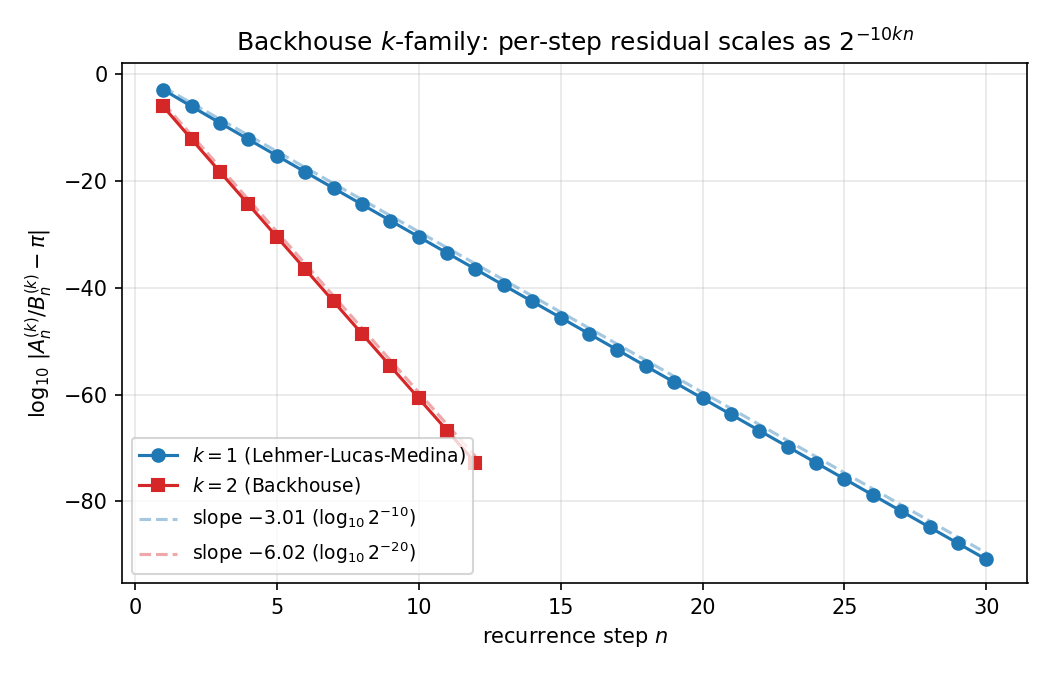
Per-step residual $|A_n^{(k)}/B_n^{(k)} - \pi|$ for $k=1$ (slope $-3.01$) and $k=2$ (slope $-6.02$). Dashed: predicted slope $\log_{10} 2^{-10k}$. Verified to 200 dps in code/backhouse_pi_plot.py.
The dashed reference lines match the per-step rate $2^{-10k}$ derived algebraically above. As discussed below, this is the per-step rate of the discrete recurrence; the continuous-time PIVP rate is set independently by the driver eigenvalue at $w = 0$.
Why this works where MUM constructions fail
Many natural strict-GPAC attempts on π hit the $z = 0$ fixed-point obstruction. The Chudnovsky / Ramanujan / Apéry generating functions are MUM at $z = 0$ — their Picard-Fuchs ODEs have an indicial equation with all roots equal at the origin, so analytic-branch values at $z = 0$ are zero, and a polynomial PIVP whose drive vanishes at $z = 0$ cannot launch the trajectory away from there. The forward construction stalls.
The Backhouse-Lehmer construction sidesteps this entirely. The generating function $G_R^{(k)}$ is regular at $z = 0$ (with rational IVs $R_0^{(k)} = 0$, $R_1^{(k)} = $ explicit rational), and the simple pole that delivers π lives at $z^* = -1/(-4)^k$, away from the origin. The drive $\dot z = -(-4)^k(z - z^*)$ does not vanish at $z = 0$, so launching from $z(0) = 0$ with rational IVs sends $z(t)$ exponentially toward $z^*$ in finite continuous time.
The reason this works is structural and specific to the $1/(1 + x^2)$ denominator in the integrand: the imaginary roots $x = \pm i$ are exactly where $i^m(1-i)^n$ collapses to $(-4)^{kn}$ on the Eisenstein lattice when $4 \mid 2m - n$, leaving a clean two-term decomposition with no $\ln\sqrt 2$. None of this generalizes straight to higher-dimensional Beukers integrals (the natural ζ(2) and ζ(3) attacks). For those, MUM is the real obstruction, and a different bypass is needed (the reverse-flow Levelt-renormalization construction, which is the topic for the paper’s ζ-side, not this post).
What the knob $k$ buys, and what it does not
It is worth being explicit on this, because the per-step rate table above can mislead. Two distinct rates are in play.
The per-step rate $2^{-10k}$ is a property of Backhouse’s symbolic identity. It says: between consecutive integer indices $n$ and $n+1$, the residual $|R_n^{(k)}/B_n^{(k)} - \pi|$ shrinks by factor $2^{-10k}$. This is what one would track when running the recurrence discretely on a piece of paper, or in floating-point arithmetic with $n$ as an iteration counter.
The continuous-time rate of the PIVP is the rate at which the state-space readout $G_R^{(k)}(z(t))/G_A^{(k)}(z(t))$ approaches π as physical time $t$ grows. With drive $\dot z = -(-4)^k(z - z^*)$, one has $z(t) - z^* \sim e^{-(-4)^k t}$ (or $e^{-|(-4)^k| t}$ after sign care). The leading singular behavior at $z = z^*$ then dictates an exponential rate in $t$ proportional to $|(-4)^k|$.
These two rates are not the same quantity, and translating between them requires fixing how $n$ is parametrized into $t$. In the natural PIVP encoding, the “rate” the user experiences in the readout is the continuous-time one, which scales with the drive eigenvalue $|(-4)^k|$ at the pole. The per-step rate $2^{-10k}$ shows up only after one re-discretizes — and even then, what one really gets is exponential in $t$ at rate $|(-4)^k|$.
So the honest summary of what $k$ buys:
- Yes: every $k \ge 1$ is a strict-GPAC PIVP for π with all states bounded natively, no surrogate compilation needed. Each $k$ encodes a different generating-function identity from Backhouse’s pancake family.
- Yes: the symbolic per-step rate of the underlying recurrence scales linearly with $k$. This matters if one is doing arithmetic with the discrete sequence — every increment of $k$ multiplies the digits-per-step by $\approx 3$.
- No: raising $k$ does not by itself accelerate the continuous-time PIVP convergence in the way the per-step rate table might suggest. The continuous-time rate is set by the drive eigenvalue at the pole, and is exponential in $t$ for every $k$. Trading $k$ against state count and against per-step rate of the symbolic recurrence is the actual content of the family.
The takeaway is that Backhouse $k$ delivers a family of strict-GPAC π constructions — not a single rate-tunable construction. The $k = 1$ case (Lehmer-Lucas-Medina) is already exponential-in-$t$ and native-bounded; higher $k$ trades state count and recurrence depth for a different generating-function identity, not for a faster PIVP.
A separate question, and where it stands
A different question — strict-GPAC for π via a route that does encode the Chudnovsky / Ramanujan modular series structure, with no scalar inverter — is closed by an entirely different construction (reverse-flow Levelt regularization at the rational evaluation point of the Picard-Fuchs ODE, plus an even-power attractor materializing the irrational normalization, plus a scaled-branch adaptation law that lets π emerge as a normalization factor rather than as a reciprocal). That construction is universal across MUM Picard-Fuchs constants — it covers π via Chudnovsky/Ramanujan, ζ(3) via Apéry, ζ(2) via the dilogarithm at $z = 1$, and π² via Hata 1990’s double integral — at the cost of surrogate compilation for an unbounded auxiliary clock. The Backhouse $k$-family does not need that compilation, but is specific to π and to the algebraic accident that $1/(1 + x^2)$ partial-fractions cleanly at $x = \pm i$. Both routes are real, and they are complementary; this post is about the Backhouse one.
Code
code/lehmer_simulate.py— verifies the $k = 1$ asymptotic slope $\log_{10}|J_n - 0| \approx -3.02\, n$code/backhouse_k2.py— verifies $k = 2$ asymptotic slope $-6.04\, n$code/backhouse_k2_Q.py— symbolically derives $Q_2(n)$ as a degree-14 polynomial via Lagrange interpolation over 20 sample pointscode/backhouse_k2_recurrence.py— symbolically derives the order-2 recurrence on $R_n^{(2)}$ with degree-15 coefficients, verifies $n = 0, \ldots, 12$
References
- N. Backhouse, Pancake functions and approximations to π, Math. Gazette 79 (1995), 371–374.
- S. K. Lucas, Integral proofs that 355/113 > π, Amer. Math. Monthly 116 (2009), 41–48 — gives the $A_n / B_n / U_n$ closed forms in eq. (11).
- D. H. Lehmer, original $J_n$ integral, Amer. Math. Monthly 92 (1985), 449–450.
- L. Medina, the 1944 partial-fraction decomposition that Lucas extracts in modern form.
“君子有终身之忧,无一朝之患也。” — from Mencius §IV.B.28. A junzi has lifelong concerns, not a single morning’s worry. The π construction is one morning’s work; whether the same algebraic accident extends to ζ(2), ζ(3), ζ(5) is the lifelong concern.