Newton's Method, Complex Dynamics, and the GPAC Connection
2026-03-30
From Root-Finding to Fractals
On March 28, 2026, I attended a fascinating plenary talk by Paul Blanchard (Professor Emeritus, Boston University) at the ISMAA meeting held at UIS. The talk, titled “Newton’s Method: Complex Numerics and Complex Dynamics”, offered a visual and historical journey into what happens when a classical numerical algorithm is turned into a complex dynamical system.
The story begins with a historical problem: finding roots of polynomials. While the quadratic formula has been known since antiquity, and solutions for cubics and quartics were found in the 16th century, Niels Henrik Abel proved in 1824 that no general radical formula exists for polynomials of degree 5 or higher.
To find roots of higher-degree polynomials, we rely on numerical approximations—most famously, Newton’s Method. For a differentiable function $f(z)$, the Newton iteration is defined by:
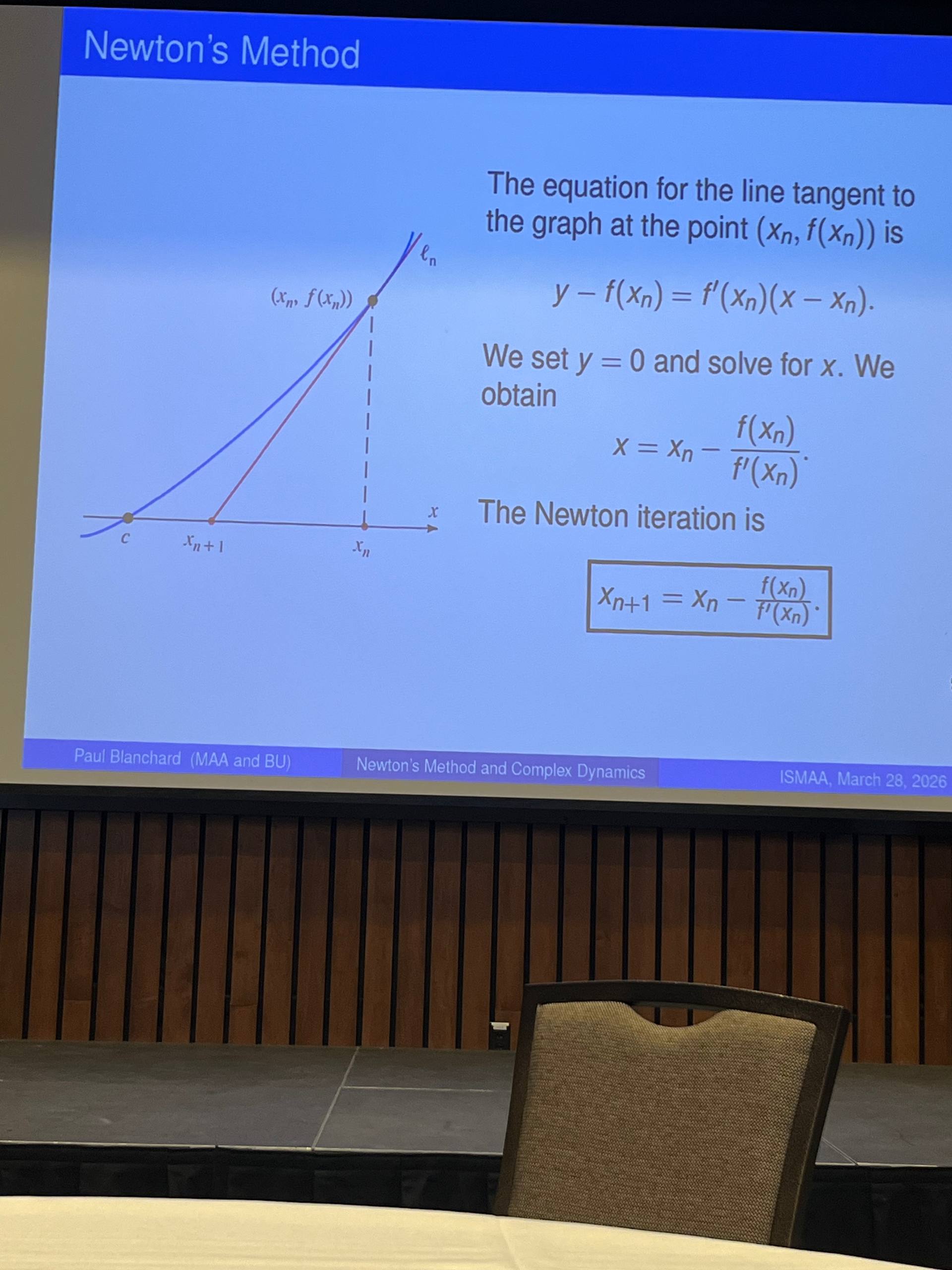
If you start with an initial guess $z_0$ close to a root, the sequence $(z_n)$ usually converges to that root very quickly. But what happens if you apply this to complex polynomials and look at the global behavior of all possible starting points?
Basins of Attraction and Chaos
When Newton’s method is applied to a polynomial $p(z)$ on the complex plane (or Riemann sphere), the update rule $N_p(z) = z - p(z)/p'(z)$ is a rational function. Iterating this rational function creates a discrete dynamical system.
Blanchard showed what happens when we color each starting point $z_0$ based on which root it eventually converges to. The regions of points that converge to a specific root are called basins of attraction.
For the simple cubic polynomial $f(z) = z^3 - 1$, there are three roots: $1, e^{i2\pi/3}, e^{i4\pi/3}$. If we color their respective basins red, green, and blue, we get one of the most famous and beautiful fractal images in mathematics:
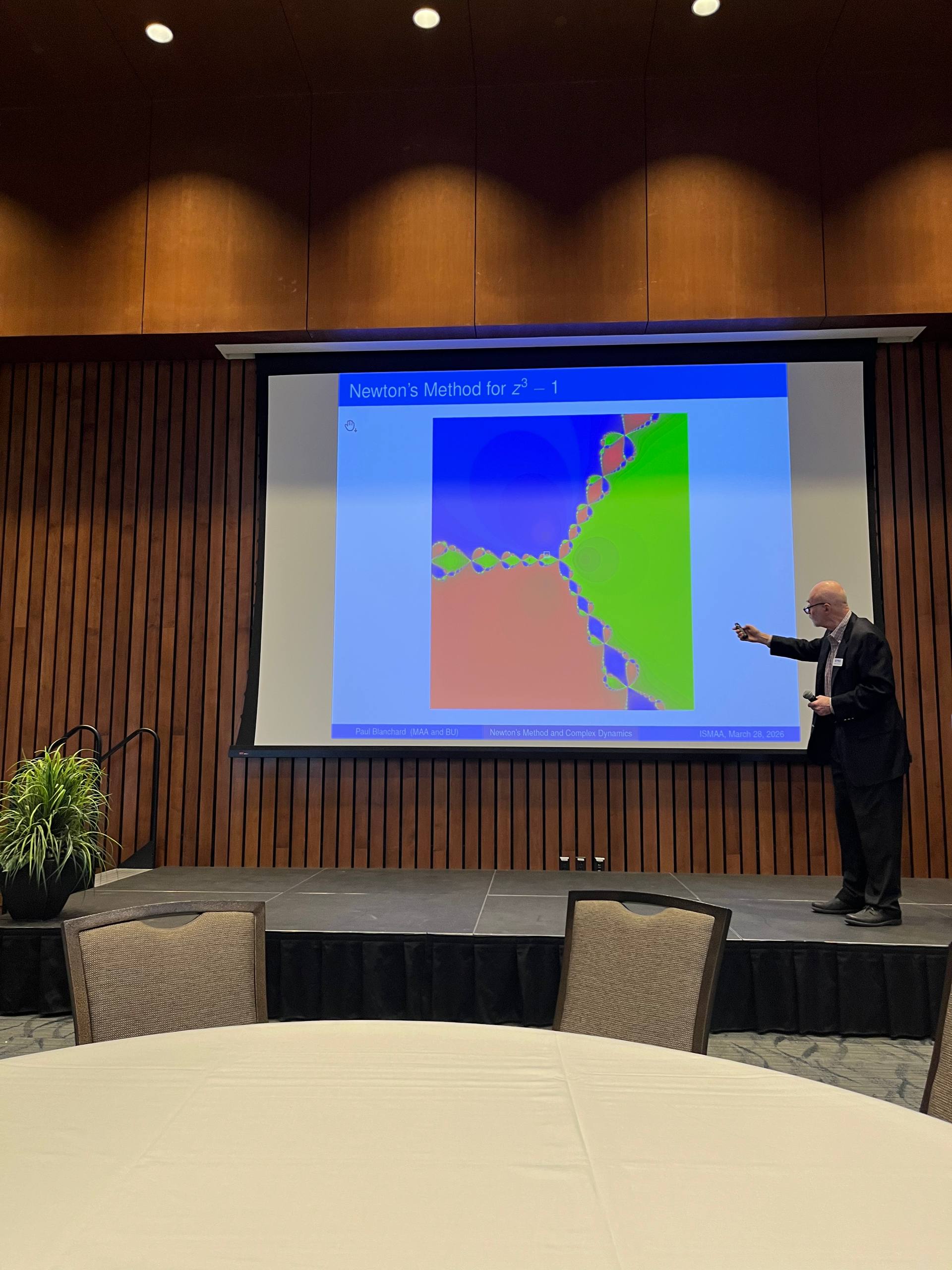
The boundary separating these basins is incredibly complex—it is the Julia set of the rational map $N_p(z)$. In fact, any point on the boundary is adjacent to all three basins simultaneously. The dynamics on the Julia set are chaotic, while the dynamics in the interior of the basins (the Fatou set) are stable and predictably converge to the roots.
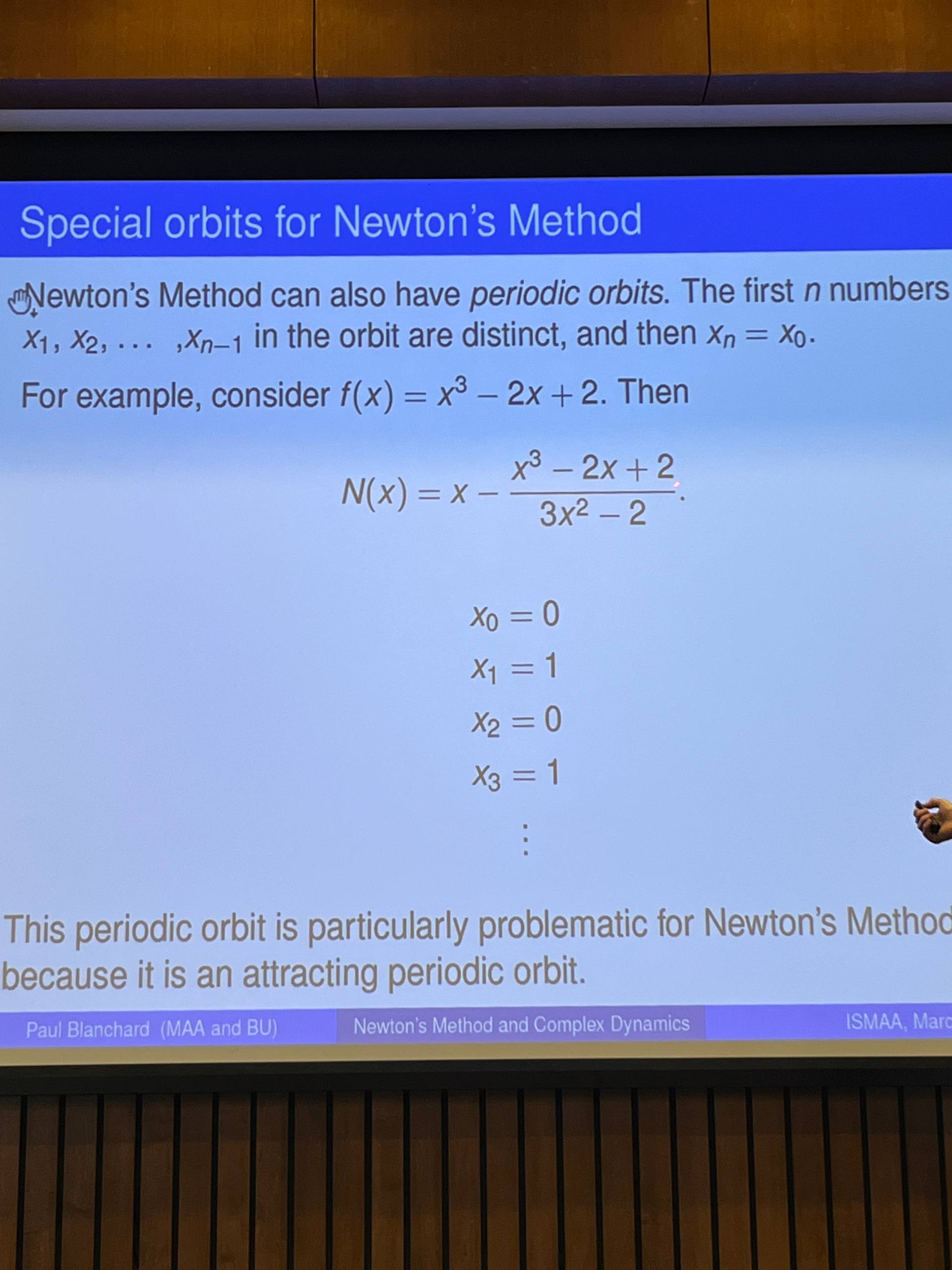
But Newton’s method doesn’t always work perfectly. Blanchard highlighted cases like $f(z) = z^3 - 2z + 2$, where the Newton map has an attracting periodic cycle (bouncing between 0 and 1). If your initial guess falls into the basin of this cycle, the iteration is trapped forever and never finds a root!
A Future Hook: Continuous Dynamics and the GPAC
As I listened to the lecture, I couldn’t help but think about the connection to my ongoing research on Chemical Reaction Networks (CRNs) and the General Purpose Analog Computer (GPAC).
Newton’s method is traditionally a discrete iterative process. However, we can construct a continuous analog. The continuous Newton’s method for a polynomial $p(z)$ is defined by the ordinary differential equation (ODE):
Because $p(z)$ and $p'(z)$ are polynomials, the right-hand side is a rational function.
This is where the connection gets exciting: the GPAC is fundamentally a machine that solves polynomial ODEs. Through techniques like the quotient rule transformation, rational ODEs can be simulated by polynomial ODEs by introducing auxiliary variables. This means the continuous Newton flow—and its complex phase space of basins—can, in principle, be exactly generated by a bounded GPAC or a mass-action CRN!
Furthermore, translating discrete iterations into continuous ODEs without accumulating error is a core challenge in analog complexity. This is evident in tools like Machin-style formulas for computing $\pi$, where state updates must rely purely on polynomial difference equations (using only addition and multiplication) to avoid division errors until the final readout.
Can we map the fractal boundaries of discrete Julia sets to the asymptotic convergence properties of bounded polynomial ODEs? If a discrete iteration gets trapped in an attracting cycle, does the corresponding continuous GPAC circuit oscillate infinitely?
These questions bridge the gap between classical complex dynamics (Fatou-Julia theory) and modern analog computability. It is a direction I am actively keeping as a hook for future work in the Bounded Analog Complexity project.